MENU
The CRP/ Centre régional de la photographie based in Douchy-les-Mines (France) presents a group show of the work of four emerging Chinese photographers, the result of a curatorial dialogue between Hu Ruohao, a young curator from the Canton region, and Audrey Hoareau, director of the CRP/.
BI HU SUO: About the emerging Chinese photography
The CRP/ Centre régional de la photographie based in Douchy-les-Mines (France) presents a group show of the work of four emerging Chinese photographers, the result of a curatorial dialogue between Hu Ruohao, a young curator from the Canton region, and Audrey Hoareau, director of the CRP/. The show is entirely produced by the CRP/.
In mandarin, Bi Hu Suo means “shelter”. This show identifies emerging Chinese photography as a territory of exploration, so the title is indeed apt. In recent years, China has seen the advent of a prolific and tumultuous new photography scene. It is fascinating to examine the burning issues of a generation of artists, confronted and even stimulated by the charge of power and history of such a complex nation. The internationalisation of Chinese students, in particular in the arts, has freed up their approach to artistic expression and the societal themes they tackle. This show has chosen the work of four artists for their ability to adapt their creative process and their unforeseen, roundabout approach to their subjects. Zhang Zhidong, Zeng Andong, Ye Wuji and Wang Yingying tackle thorny issues like Sino-American relations, the cultural revolution, national security and gender, never shying away from sensitive, relevant yet delicate subjects. As an art centre that is resolutely turned outward, committed to representing all facets of photography and equally committed to free speech, the CRP/ is delighted to provide a platform for this excellent work, and in the process, to highlight young Chinese photography.
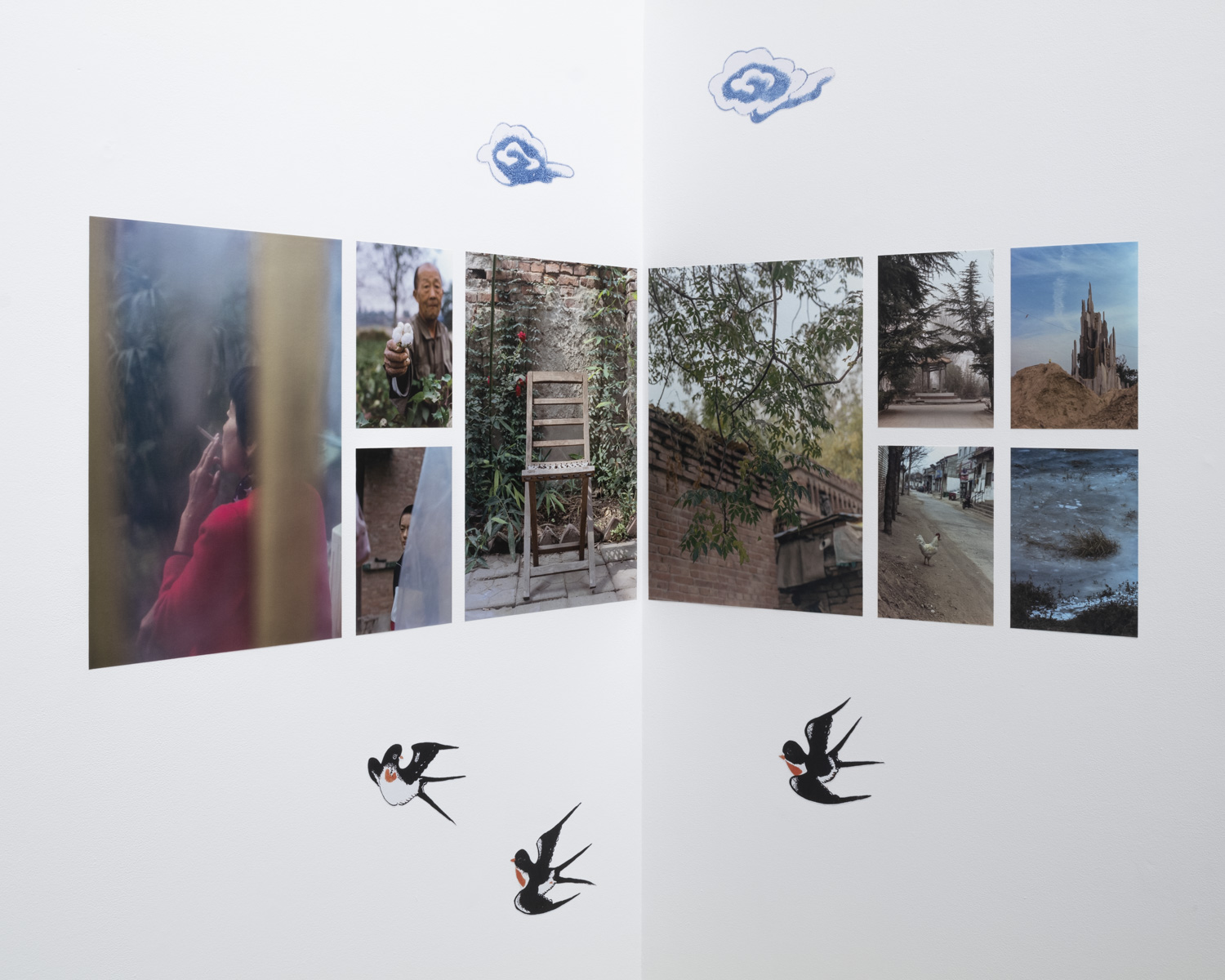
Below some exhibition views (Courtesy of CRP/)
The up-and-coming photographers in this group show explore the many realities of life in China. Not unlike collectors, they gather fragile ends, fragments, treasures, micro-narratives plucked from their personal experience, or, on the contrary, they dig into the folds of territories that hide mute stories of ghosts wandering between past and present.
Zhang Zhidong uses photographic images as the material for creating mysterious puzzles. He both reveals and eludes snippets of a queer narrative that he claims without showing himself. A seeker in the middle of the desert, Zheng Andong gets down to ground level to reveal the forgotten traces of Chinese workers in an attempt to rewrite the story of the Chinese diaspora while questioning his own identity. Through a blend of photography, drawing and documentary writing Wang Yingying puts the pieces of his family back together after the split caused by the cultural revolution. Ye Wuji creates an inventory of the semiology of the security measures in a small town in Western China, listing the absurd barriers that pepper the everyday lives of the locals like so many obstacles in a game that is all too real. While the approach of each of these young artists differs both in theme and treatment, they all show a pressing need to share their experiences, their research and their confusion, to connect with the rest of the world.
However, it is sometimes difficult to stir up memories and emit doubts in the environment in which they are working. So often, they are obliged to keep their desire for change to themselves. This show is designed to fill that gap, to bring these solitary voices together in a safe place, to provide a refuge where they can tell their stories without fear, the composite confessions of men and women as they are. These narratives will resonate well beyond their starting points in China or elsewhere, as we know all too well that history inevitably repeats itself and our lives are so similar.
Hu Ruohao,
Exhibition co-curator.
Zhang Zhidong
Natural Impersonation
Zhang Zhidong explores gender identity in a context of China’s repression of homosexuality. He creates worlds that transpose his friends and family into an alternative, subversive reality, in doing so denouncing the constraints of a heteronormative system.
Biography
Zhang Zhidong is originally from Hunan Province and graduated from Central South University in Changsha with a degree in Applied Mathematics. He continued his studies in the United States and has a Master of Fine Arts (MFA) from the Massachusetts College of Art and Design. He lives and works in Boston (United States).
Zheng Andong
A Chinese question
Zheng Andong examines Chinese migration to the United States in the 19th century and its consequences in the present day. His work is based on concrete facts, as he uses documentation such as the Chinese Exclusion Act or the written accounts of the construction of North America’s first transcontinental railroad, that feature many Chinese workers of whom no trace remains. Zheng Andong mixes past and present by revisiting historic sites meeting stakeholders in the present, in order to examine the sensitive issue of integration.
Biography
Zheng Andong was born in Hefei in Anhui Province in 1992. He graduated from the University of Tongji in Shanghai with a degree in engineering, and continued his studies in the United States with a Masters in Fine Arts from the Rhode Island School of Design in 2019. He lives and works in Shanghai.
Ye Wuji
MGBS
Ghulja is located in Xinjiang Province, in the north west of China, close to the border with Kazakhstan. In recent years, it has seen many violent riots and terrorist attacks. A considerable number of security barriers have been installed in order to keep the peace. Ye Wuji’s work examines these static, silent symbols of power and constraint. In 2016, he organised a competition to choose the “most beautiful security barrier” based on a field survey. He spent seven days surveying 520 citizens from different ethnic groups on their opinions of twenty barriers. Years later, his morale sapped by the increasingly dire situation, Ye Wuji reinterprets his initial project with a video piece that uses “the few words we are allowed”.
Biography
Ye Wuji was born in Wuhan in 1991. He graduated from the Sichuan Fine Arts Institute, Oil Painting Department, in 2014. He went on to obtain a Fine Art MFA at Goldsmiths, University of London. He lives and works in Shanghai. Ye Wuji is interested in the permanence of the myths, narratives or concepts on which modern societies are built. He uses various media to explore their representation and their impact in everyday life.
Wang Yingying
Where my heart settles down
Wang Yingying’s parents met when her father was exiled to Wangqiao for 17 years as part of an anti-right campaign. After the Cultural Revolution, her father returned to Peking while she, her mother and brother remained in Hangzhou. The distance eventually led to her parents’ divorce. Deeply affected by the split, and the absence of a father figure, Wang Yingying’s work examines her own identity issues and her return to the place she was born in 2015.
Biography
Wang Yingying was born in Guantao in Hebei province in 1976. She is an independent photographer and documentary film maker. Her work is essentially biographical, focusing on women’s inner lives and fates. She has an art degree and she lives and works in Hangzhou.
About the co-curator Hu Ruohao
Hu Ruohao lives and works in Canton. Since 2014, he has been in charge of coordination and international relations at the Lianzhou Foto Festival, one of the most important photographic events in Asia and worldwide. In 2017, he shepherded the establishment of the Lianzhou Museum of Photography, the first public photography museum in China. Since then, he has contributed to the development of its consistently excellent international programme. Hu Ruohao oversees the editorial policy of both the museum and the festival and works regularly as an independent curator.
About the The CRP/ Centre régional de la photographie
The CRP/ Centre régional de la photographie based in Douchy-les-Mines develops art centre missions in the field of photography and contemporary images.
Founded in 1982, the CRP/ grew out of a collective of photographers who came from the photo club of the Usinor Denain Work Council. As a mobile association at the time, the CRP spent four years developing exhibitions and organising photography competitions. In 1983, in connection with its photographic commissions and its production of works, the Ministry of Culture recognised the CRP/’s art library, which became the first of its kind in France in the field of photography. In 1986, the CRP/ moved in to a former post office made available by the town of Douchy-les-Mines, and in 1991 the Ministry of Culture recognised it as a national art centre.
As a centre that supports creativity, at the outset it developed a project to commission works linked with its territory: the Mission Photographique Transmanche (1988 to 2006), which lay the foundations of its collection.
This has since been supplemented through the art centre’s programme and productions. The CRP/ is one of the few art centres endowed with a collection directly linked to its own production activity. The CRP/ collection currently contains almost 15,000 works, with an art library offering the public over 500 works that may be borrowed. Linked to its significant publication activity, it also has a document collection of over 9000 books.
The CRP/’s activities include creative support, research, production, distribution and mediation, all of which is developed in a region that is marked by its industrial past, an area that showed a very early commitment to culture. Today the CRP/ is a place of experience transmission, awarenessraising, mediation and training in the field of images, with a transregional and national reputation.
The CRP/’s artistic and cultural vision, endeavours to be forwardlooking, encouraging young artists through its research and support mission, keeping in mind the regional history of images to which its collection testifies. It is regionally rooted while also giving attention to other art scenes abroad, through invitations to artists who come and shift or renew visitors’ perceptions of their history and region, and provide access to other cultural and societal issues in the world.
More information:
BI HU SUO: About the emerging Chinese photography
Dates: May 7 - August 2022
CRP/ Centre régional de la photographie Hauts-de-France
Place des nations, 59282 Douchy-les-Mines (France)
www.crp.photo